Again the Huai Blossoms Are in Bloom
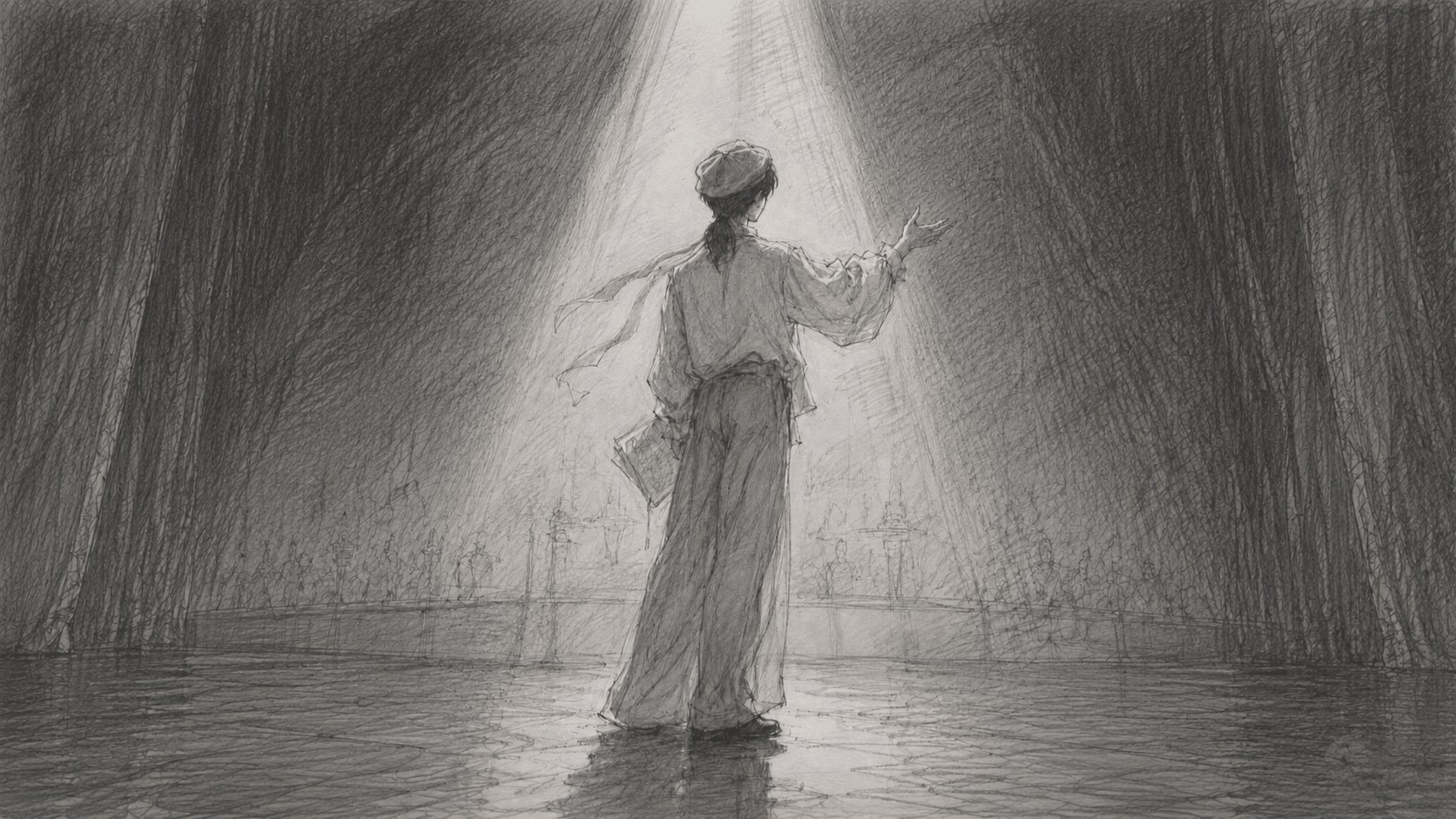
Again the huai blossoms are in bloom.1
Today, as I always do, I open that chat window, type out a single line, Good luck on the gaokao2, and hit send. I know there won’t be a reply. This is the sixth year. Then I go back to my packing. Next week I leave for somewhere far away, to begin my life at university.
High school is ending. I ought to feel what everyone else feels: a long breath out, and then a proper celebration. But standing here at this threshold, all I feel is that everything has ended too fast, fast enough to leave a hollow behind. So I do the thing I have done at every turning point these past five years: I look back at the person who receives those messages.
Her name is Hongchen.3 It’s a username. In those years none of us liked to give our real names online; I myself only started using mine a couple of years ago. She is probably the one thing in these five years that has never changed. Only by setting myself beside her can I measure how far I have actually come.
I was eleven when I met her, in the fifth grade.
I met her on a Chinese Minecraft server. To most adults, that probably sounds like nothing more than a game, one more place where children waste their afternoons. To me, at eleven, it was the first world in which I realized that rules could be understood, rewritten, and made to obey you.
Hongchen was good at that world in a way I had never seen before. She could make things move on their own, open and close, count, respond, remember. I did not yet have the words for it, but what I was looking at was logic made visible. A few lines of commands could become a mechanism; a mechanism could become a system; and a system, if you understood it well enough, could begin to feel almost alive. To a child who had never written real code, it looked like magic. The important thing was that she did not keep the magic to herself.
She taught me patiently. Not in the grand way people describe mentorship later, but in the small, ordinary way that actually changes a life: one command at a time, one mistake at a time, one explanation after another when I did not understand. To follow her, I learned the syntax of the commands. To build more complicated things, I wandered into development groups and met people who wrote plugins and ran servers. To understand them, I opened the first code editor of my life.
Looking back now, my whole life has more or less been pushed along to this day by that one encounter. An eleven year old’s world was nudged, gently, by someone who had no reason to stop and teach him. Then it rolled, and rolled, and never stopped.
Back then I was a hot headed brat. In school, I was the kind of student adults usually liked: quiet when I was supposed to be quiet, near the top of every class, careful not to cause trouble when it mattered. But in the Chinese schools I grew up in, good grades often came with a strange kind of permission. If you were useful to the school, if your scores looked good enough, many things could be overlooked. I skipped classes, broke rules, drank when I was too young to know better, stayed away from school, and somehow rarely faced real consequences. It did not make me free. It only taught me, far too early, that achievement could buy exemption.
Inside, I was not gentle or noble at all. Like many people around me, I had learned very early to understand the world as a contest: to be better, to stand out, to prove that I was not ordinary. Online, that side of me came out without restraint. I’d picked up a bit of programming and was desperate to prove myself: lording it over everyone, picking fights with anyone, always needing to come out on top. But beneath all that bluster, what I was hiding was pure inferiority. The circle was full of high schoolers far better than me; the things they tossed off without a thought were heights I couldn’t reach after staying up for nights on end. In my eyes they were the big shots4, beings I couldn’t even dream of touching. I hated myself for not being clever enough, and I hated them for being clever at all.
That contradiction never really left me. I was ambitious, easily impatient with stupidity, and at the same time deeply afraid that I might be stupid too. Later, through work and through the wider world, I began to meet adults who had once gone through the same exams, the same pressure, the same machinery of competition, and yet their minds had moved somewhere else. They cared about consequence, steadiness, responsibility, sometimes even kindness in ways I did not yet understand. Standing between my peers and those adults, I often felt split in two: too young to be free of the hunger to win, too aware to believe that winning was enough.
That tangled knot of looking up to someone and envying them at the same time, wanting to be stronger while fearing that I was never strong enough, I never told a soul.
I never imagined that one day I would break with them, by my own hand, in disgust.
Hongchen wasn’t one of that crowd.
In terms of skill, she honestly wasn’t any stronger than those big shots; but I never minded. She had a mature way about her, and we were the kind of friends who could talk until the small hours. I can barely remember now what we actually talked about, only that there was someone on the other end who never found you childish, never had to win. In a circle where everyone wanted to come out above everyone else, she was one of the rare people who made me feel safe. Back then my greatest wish was that someday the two of us might meet.
That wish never got its chance. Half a year before her gaokao, we slowly drifted, talking less and less, until one day she said she was going offline for good. I said: all right, I’ll wait for you. And then she vanished from that world.
What truly changed me came later, when I met one of the big shots.
In person, this time. The man I had once looked up to sat there across from me, and up close, his face was a sleazy thing. He sponged off people, ran little scams, and eventually stirred up a real mess in our circle. The halo shattered, completely. In that moment I understood that some of what I’d chased for so long was simply hollow. Between me and that circle, a crack opened that could never be patched.
That was also when I drew my eyes back from other people and began, with my feet on the ground, to learn programming and math on my own. I was not riding on anyone’s halo, just sinking roots, inch by inch. To this day I still loathe “performative learning”: effort that is all posture, staged for an audience. I have seen its ugliest face.
People who sink roots tend to meet light in unexpected places.
I started a blog, and through it met many friends much older than me. One of them introduced me to the person who is now my university mentor. And so, at this age, I was handed a rare chance: the freedom to do research. It wasn’t something I had planned, more like a ticket fate slipped into my hand once I had finally agreed to be steady.
In 2024 I made the biggest gamble of my life: I left my hometown to study, alone, somewhere far away.
I had to adapt, from scratch, to a language entirely foreign to me. When I first arrived I couldn’t get out a single whole sentence, and had no idea what was waiting ahead. That composure I’d always been so proud of probably shattered to pieces the moment I stood there stammering, unable to string one complete thought together. I knew it perfectly well: if it weren’t for the one skill in my hands, I would never have dared make so large a bet. And the seed of that skill traces back to that one person, when I was eleven, who was willing to teach me.
I have an adaptability that frightens even me.
In a place where I knew no one, I started out not knowing how to make friends, not knowing how to talk to teachers, and yet before long I had found my footing. What people saw was, more or less, someone adapting fast and walking steady. But only I knew that beneath the steadiness, a wire was always pulled taut.
These past two years I pushed myself harder than I ever had. I raced through coursework ahead of schedule; I reached past school for every opening I could find, anything that might carry me a step further. Some of it was ambition. But a larger part, the part I rarely say out loud, was simpler than that: money was tight at home, and I couldn’t afford to be someone who waits and sees. I needed every door I could pry open.
And the doors I needed most kept shutting. I applied for scholarship after scholarship, and the rejections came back as politely as ever, one after another. Here is what I cannot swallow: anything decided on ability alone, a test, a proof, a thing with a right answer, I can take, every time. It is the other kind I lose: the kind judged not on what you can do, but on how gracefully you perform being likeable; the awards that go, so reliably, to whoever sits down across the table and turns out to be exactly what the table was hoping for.
The more I came to understand how universities work from the inside, the more painful this became. I knew too well how easily their language of merit could turn into a language of fit, polish, and institutional comfort. They say they are looking for potential, but too often what they recognize is the performance of potential: the student who knows how to appear inspiring, grateful, palatable, and safe. Real academic hunger is rougher than that. It is obsessive, impatient, sometimes uncharming. It does not always enter the room smiling in the right way. Knowing this did not make me detached or wise; it only made every polite rejection hurt more, because I could almost see the machinery behind the kindness.
On paper I am everything the brochures claim to be looking for. In the room, somehow, I am never quite it. I’m sure they have a word for what I’m missing; they just phrase it more kindly than that.
I’m not really composed. I’m just too afraid of not being good enough, too afraid of being seen as weak, too afraid that the moment I slow down I’ll be knocked back into that hot headed, insecure kid. So I drive myself to do everything as well as I can; I drive myself to look clear headed, strong, sure of where I’m going. My intensity, my “excellence,” all those goals of mine that look so far beyond my peers, much of it isn’t because I am more certain than other people. It’s because I am more afraid to lose.
Right now my classmates, the ones graduating alongside me, most of them a year older than I am, are celebrating the end of high school, full of joy. And I, out of some feeling I can’t quite name, never want to take part, and can’t feel happy at all.
I know that I am often utilitarian to the extreme, hard on myself, indifferent to most things. That coldness sits oddly here, out of place. And yet my high school friends are such genuinely, genuinely good people. They can take real joy in a dance, a dinner, a graduation party; and standing among them, I feel envy and sorrow at once. I carry so much more than they do, and I learned far earlier to keep pushing myself forward. Even standing among them, there is a voice in me that never quiets: you can’t slow down; there is too far still to go.
The greatest irony is this: I so despise performative learning, and yet every day I am performing an adult, an adult I can hardly recognize, faking his composure.
But it isn’t all cold.
Of the very few things that have genuinely challenged me these past years, French may have been the first. It was the first time in a long while that something made me struggle, made me feel clumsy, and made me want to keep going anyway. No one had asked me to learn it; I simply chose to. Maybe that is exactly why my favorite teacher has always been the one who teaches it.
And more than the language itself, it was this change of surroundings that made me realize something. I had already gotten out, out from under an education built on pressure and constant negation, the kind that called grinding a child down “discipline,” and trained you to brace, always, for the next reminder that you were not good enough. Here, no one was trying to grind me down. And yet I have come to understand that leaving such a place, and leaving what it carved into you, are not the same thing. Those marks are still branded deep in me, and they are, I think, a large part of why I cannot let myself slow down, why I am still so afraid to lose.
And then there is cooking. At the stove I am not performing anyone, not the prodigy, not the candidate, not the composed young adult faking his way across a room. Sometimes I think that if I never end up a professor, I might just become a chef. It is the one place where being good at something asks no performance of me at all.
Next week I leave for somewhere far away, to start over. I’m lost, I’m nervous, and I’m gripped by that hollow feeling of everything ending too fast.
It is at thresholds like this that I think of Hongchen again. She left at eighteen, on her way to the gaokao; and I, three years of middle school, two of high school, racing ahead the whole way, am almost at the same crossroads where she once stood. Only she is no longer there. Everything that came after, the blog, the mentor, that gamble, everything I have managed to do, she never saw any of it. The person she knew will always be that hot headed, insecure kid, hiding behind a username.
So every June, the line I send out is really a report she may never receive again: Look, that kid you nudged along, all those years ago, has come so far.
These six years of silence, I don’t dare think too hard about why. I don’t even know her real name. To me she was, from beginning to end, only those two characters: Hongchen. If we passed each other on the street one day, I probably wouldn’t know her. The answer I am afraid of, I have never let myself touch. Her name, of all names, is Hongchen, the mortal world3, and my greatest wish, my only wish, is simply that she is still somewhere in it, alive and well. As long as I keep sending that message each year, the wish has not yet been denied.
High school is ending, and my youth, I suppose, is ending along with it. I don’t know what lies ahead, but I know exactly how I got here: at eleven, there was someone who was willing to stop, and teach a kid who knew nothing.
Hongchen, if some corner of this world is where you are, and you happen to read this far: you don’t have to reply. I only want you to know, as long as you are still living, and living well, that is enough.
The huai blossoms are in bloom again.
Again the huai blossoms are in bloom;
the things remain, the people gone, and so all things are done.1
Notes
1. “Again the huai blossoms are in bloom; the things remain, the people gone…” In the original, the framing couplet reads 又是一年槐花时,物是人非事事休. I keep huai untranslated at first so that the image arrives before its meaning. The huái (槐), Styphnolobium japonicum, is the Chinese scholar tree, also called the pagoda tree; its flowering has long been linked in Chinese tradition to the examination season, as in the saying, “when the scholar tree blossoms yellow, the candidates grow busy.” The second line, 物是人非事事休 (“the things remain, the people are gone, and every matter ceases”), is a direct quotation from the Song dynasty poet Li Qingzhao (李清照, c. 1084 to 1155), from her lyric Spring at Wuling (《武陵春》). The couplet sets a deliberately classical, elegiac key against which the rest of the piece is read. ↩
2. gaokao (高考) China’s National College Entrance Examination: a single, immense, once a year exam that largely determines which university a student can attend. It is treated as one of the most decisive moments of a young person’s life, and the day it falls on, in early June, is a national event. ↩
3. Hongchen (红尘) Her username, kept here as a name. Literally it means “red dust,” a classical Buddhist and Daoist term for the mortal world, the realm of human affairs, attachments, and worldly striving, as in 看破红尘, “to see through the dust of the world.” The closing wish, that she is “still somewhere in it,” is therefore a quiet pun: he is wishing that she is still somewhere in the mortal world, i.e. still alive. English can only gesture at this, which is why the gloss is folded into the final lines. ↩
4. the big shots (大佬, dàlǎo) Internet slang for a revered expert or “heavy hitter,” used especially within tech and gaming communities for the people everyone else looks up to. ↩
Comments